Tournament day arrives, and suddenly your perfectly practiced serves feel foreign. Your hands shake during warm-up, and that confident mindset from practice sessions seems to vanish. Sound familiar? Tournament anxiety plagues pickleball players at every level, from recreational competitors to seasoned pros.
The mental side of pickleball deserves the same attention as your physical skills. Just as you dedicate hours to perfecting your dink shots and third shot drops, developing pre-match mental strategies can dramatically improve your tournament performance.
Understanding Tournament Anxiety in Pickleball
Competition nerves manifest differently for each player. Some experience physical symptoms like sweaty palms, rapid heartbeat, or muscle tension. Others deal with mental challenges such as racing thoughts, self-doubt, or difficulty concentrating on strategy.
These reactions occur because your brain perceives the tournament environment as high-stakes. The presence of spectators, brackets, and potential rankings changes triggers your body's stress response, even though you've executed the same shots countless times in practice.
Pre-Tournament Mental Preparation Strategies
Visualization Techniques
Spend 10-15 minutes daily visualizing successful tournament play. Picture yourself executing perfect serves, staying calm during close points, and maintaining composure after mistakes. This mental rehearsal helps your brain treat tournament situations as familiar rather than threatening.
Focus on specific scenarios: serving at match point, recovering from a bad shot, or playing against intimidating opponents. The more detailed your visualization, the more prepared you'll feel when these situations arise.
Breathing and Relaxation Methods
Controlled breathing serves as your most accessible anxiety management tool. Practice the 4-7-8 technique: inhale for 4 counts, hold for 7, exhale for 8. This activates your parasympathetic nervous system, naturally reducing stress hormones.
Progressive muscle relaxation also proves effective. Starting with your toes, tense and release each muscle group for 5 seconds. This technique helps identify and eliminate physical tension before it affects your play.
Day-of-Tournament Mental Strategies
Arrival and Warm-up Routine
Arrive early enough to avoid rushing, but not so early that you overthink. Develop a consistent pre-match routine that includes physical warm-up, mental preparation, and equipment check. Familiarity breeds confidence.
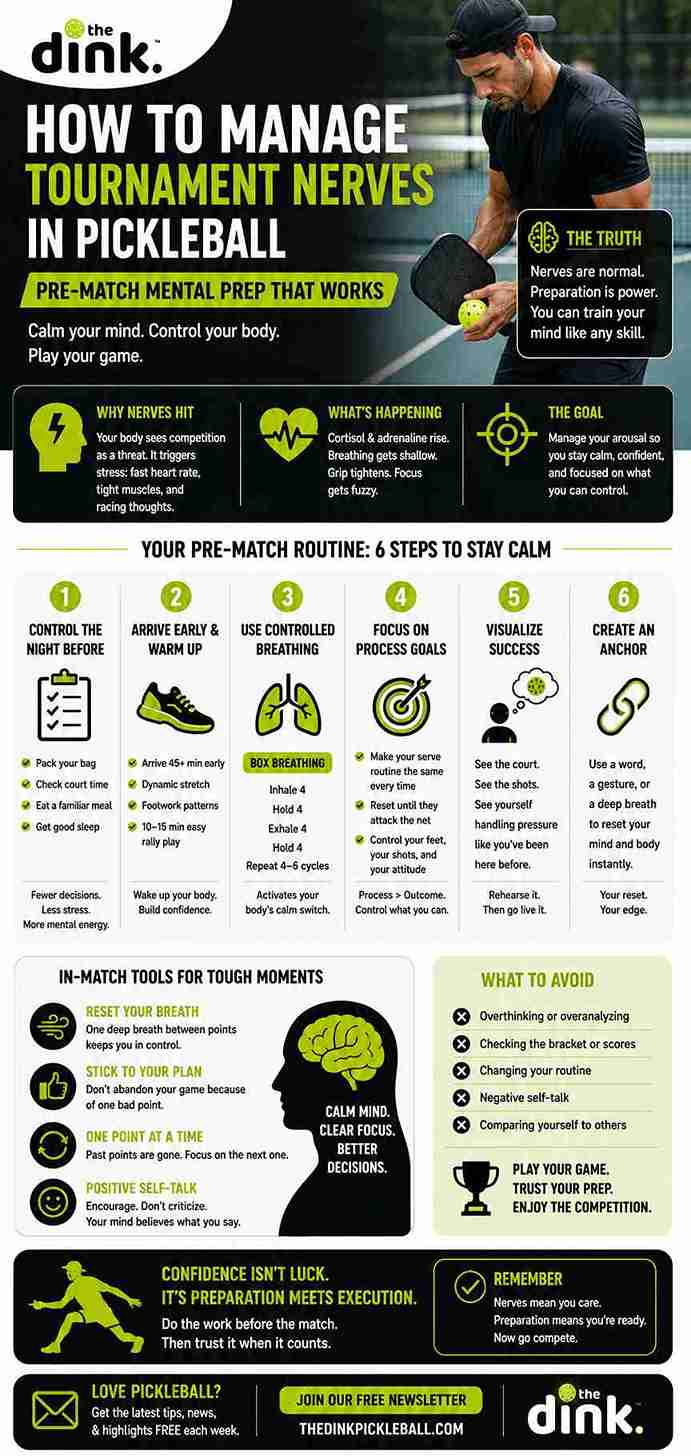
During warm-up, focus on process rather than outcomes. Instead of worrying about winning, concentrate on executing proper form, maintaining steady breathing, and staying present in each shot.
Managing Between-Point Anxiety
Develop specific rituals for between points and games. This might include adjusting your grip, taking deep breaths, or repeating a positive phrase. These actions give your mind something constructive to focus on instead of dwelling on mistakes or pressure.
Use the time between games strategically. Hydrate, review strategy briefly, and employ positive self-talk. Avoid lengthy analysis of previous points or speculation about opponents' tactics.
Reframing Tournament Pressure
Instead of viewing nerves as weakness, recognize them as evidence that the competition matters to you. Channel that energy into heightened focus and determination rather than allowing it to create paralysis.
Shift your mindset from outcome-focused to process-focused thinking. Rather than "I must win this match," try "I will execute my strategy one point at a time." This reduces pressure while maintaining competitive drive.
Building Long-term Mental Resilience
Mental toughness develops through consistent practice, just like physical skills. Regularly playing in pressure situations - even informal games with higher stakes - helps desensitize your nervous system to competitive environments.
Consider keeping a tournament journal documenting what mental strategies worked, what didn't, and how you felt throughout different matches. This self-awareness accelerates improvement in your mental game.
Frequently Asked Questions
How long before a tournament should I start mental preparation?
Begin mental preparation at least 2-3 weeks before your tournament. Daily visualization and breathing practice during this period helps establish these techniques as reliable tools when competition pressure hits.
What should I do if anxiety strikes during a match?
Use the time between points for controlled breathing and positive self-talk. Focus on the next point only, not the overall match situation. If allowed, take your full allotted time between games to reset mentally.
Can mental preparation really improve my tournament performance?
Absolutely. Studies show that mental training can improve athletic performance by 15-20%. Since tournament nerves often prevent players from executing skills they've mastered in practice, mental preparation helps bridge that gap.