Why the Forehand Groundstroke Dominates Pickleball
The forehand groundstroke is undeniably pickleball's most fundamental shot. Statistics show that recreational players hit forehands on approximately 60-70% of their shots, making it the cornerstone of successful court play. Yet despite its frequency, most players struggle with consistency and power due to improper technique.
A well-executed forehand doesn't just win points—it sets up every other aspect of your game. From aggressive returns of serve to defensive rally shots, your forehand groundstroke determines your court positioning, shot selection, and overall confidence during matches.
Essential Mechanics for Forehand Success
Grip Foundation
Your grip is the foundation of every successful forehand. The semi-western grip offers the perfect balance of power and control for most players. Position your hand so the base knuckle of your index finger aligns with the third bevel of the paddle handle. This grip allows for natural topspin generation while maintaining paddle face control.
Stance and Footwork
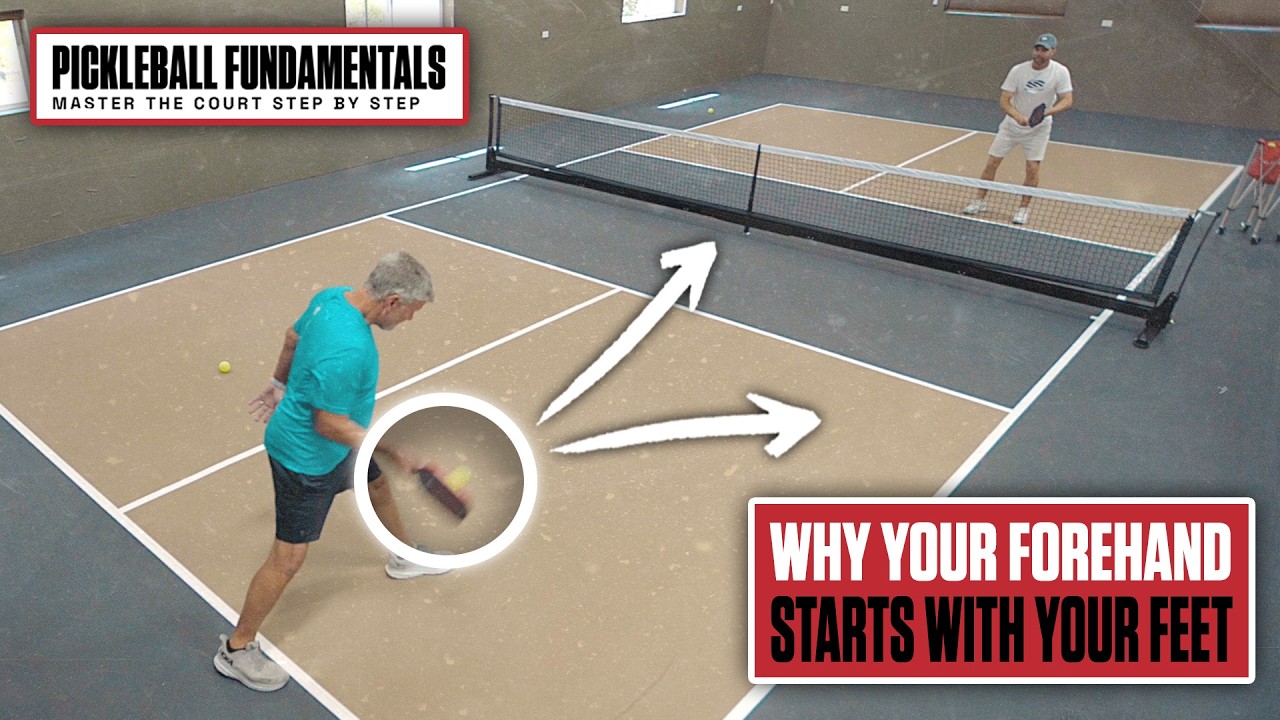
Proper footwork separates good players from great ones. Begin with feet shoulder-width apart, weight slightly forward on the balls of your feet. As the ball approaches, step forward with your non-dominant foot while rotating your hips and shoulders. This kinetic chain transfers energy from your lower body through your core to your paddle.
The key is timing this step to coincide with your forward swing, creating maximum power transfer without sacrificing balance.
The Swing Sequence That Creates Consistency
Preparation Phase
Early preparation is crucial for consistent contact. As soon as you identify the ball coming to your forehand side, begin your backswing. Keep your paddle head above your wrist level and turn your shoulders to create the proper hitting position.
Your non-paddle hand should point toward the incoming ball, helping with balance and timing. This "unit turn" prepares your entire body for the forward swing.
Contact Point Optimization
Make contact with the ball at waist height, roughly 12-18 inches in front of your body. Your paddle face should be slightly closed (angled downward) to impart topspin, which helps the ball clear the net while dipping into your opponent's court.
Contact should occur with your paddle moving in a low-to-high motion, brushing up the back of the ball. This topspin is essential for both consistency and aggressive shot-making.
Advanced Techniques for Power and Placement
Weight Transfer Mastery
Elite players understand that power comes from proper weight transfer, not arm strength. Begin with your weight on your back foot during preparation, then shift forward through your front foot during contact. This creates a "kinetic chain" that multiplies your power exponentially.
Practice shadow swings focusing solely on this weight transfer until it becomes automatic.
Follow-Through for Control
Your follow-through determines both power and accuracy. After contact, continue your swing across your body, finishing with your paddle pointing toward your target. Your chest should face the net, and your weight should be completely on your front foot.
A complete follow-through also protects your shoulder and elbow from injury by properly decelerating the paddle.
Common Mistakes That Kill Consistency
The most frequent error is hitting with only arm strength, which creates inconsistent contact and reduces power. Another common mistake is making contact too late or too close to your body, resulting in mishits and poor ball placement.
Many players also neglect their non-paddle hand, letting it hang uselessly instead of using it for balance and timing. Finally, rushing the shot preparation leads to poor footwork and off-balance contact points.
Practice Drills for Forehand Mastery
Start with stationary feeding drills, focusing on consistent contact points and proper form. Progress to moving drills where you must adjust your footwork to reach different ball positions. Finally, practice target drills to develop placement accuracy alongside power.
Consistent daily practice of these fundamentals will transform your forehand from a liability into your greatest weapon on the pickleball court.
Frequently Asked Questions
How often should I practice my forehand groundstroke?
Practice forehand mechanics for 10-15 minutes at the start of every playing session. Focus on quality repetitions rather than quantity, ensuring proper form on every swing to build muscle memory.
What's the ideal contact point height for maximum power?
Contact the ball between knee and waist height for optimal power and control. Higher contact points reduce power, while lower contact points make it difficult to clear the net consistently.
Should I focus more on power or placement when developing my forehand?
Always prioritize consistency and placement over power. A well-placed, consistent forehand at 70% power is far more effective than an erratic power shot. Power naturally develops as your technique improves.