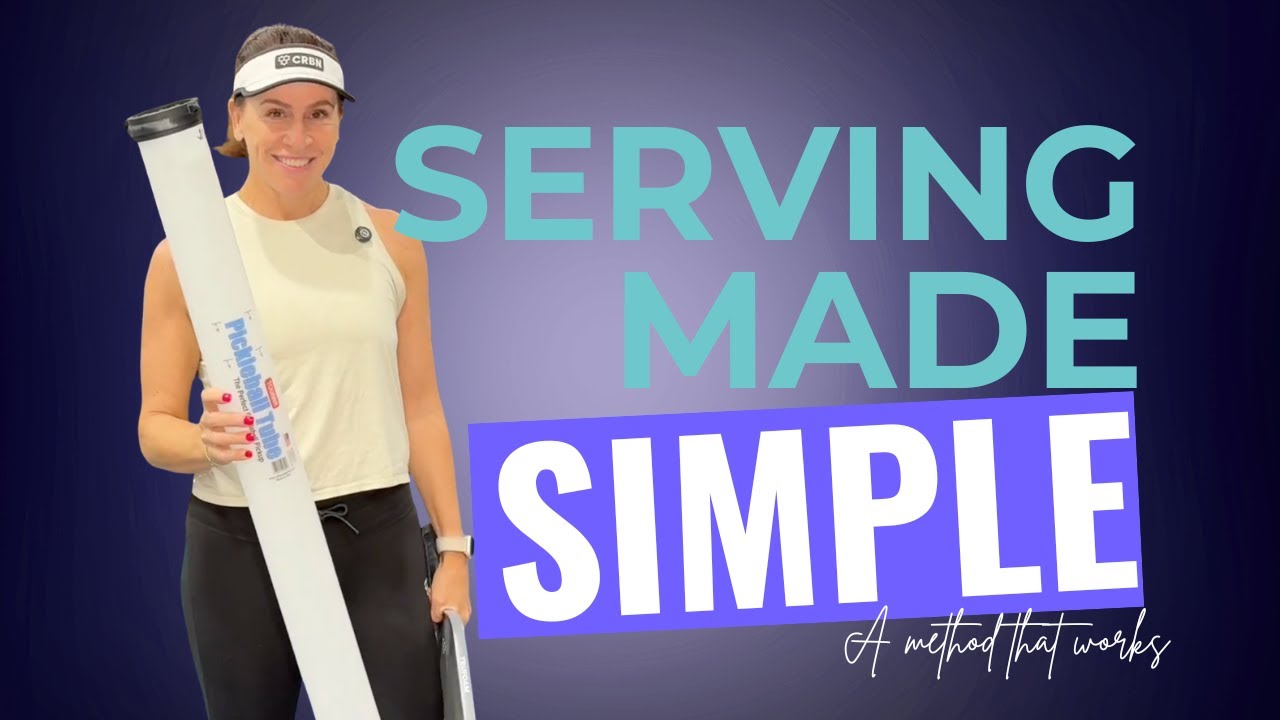
Your pickleball serve is your secret weapon on the court—yet most players treat it as an afterthought. Here's the reality: the serve is the only shot where you have complete control, no time pressure, and the ability to dictate the point from the very first contact.
Whether you're struggling with consistency or looking to add more strategic depth to your game, this proven 3-step method will transform your serve from a liability into your greatest asset.
Why Most Pickleball Serves Fail
Before diving into the solution, let's identify the common problems that plague recreational players:
- Inconsistent contact point: Hitting the ball at different heights and positions
- Poor body mechanics: All arm, no body rotation or weight transfer
- Lack of target awareness: Aiming generally "in" rather than specific zones
- Mental pressure: Overthinking the motion instead of trusting muscle memory
These issues compound each other, creating a serve that's unreliable when it matters most.
The 3-Step Foolproof Serve System
Step 1: Perfect Your Setup and Drop
Everything starts with your foundation. Position yourself with your feet shoulder-width apart, with your non-dominant foot slightly forward. Hold the ball in your non-paddle hand at about waist height.
The drop is crucial—release the ball from a consistent height every time, allowing it to fall naturally. Avoid any upward motion or spin on the release. The ball should drop straight down, giving you a predictable contact point every single time.
Practice drill: Drop 20 balls without your paddle, focusing solely on consistent release height and straight drops. Mark where the ball bounces—it should be in nearly the same spot every time.
Step 2: Master the Contact Zone
Your contact point should be when the ball is between your knees and waist, slightly in front of your body. This zone gives you maximum control while maintaining an upward trajectory to clear the net.
Use a pendulum motion with your paddle arm, starting from a relaxed position and accelerating smoothly through contact. Your body should rotate slightly, transferring weight from your back foot to your front foot as you make contact.
Key technique points:
- Keep your paddle face slightly open (angled upward)
- Contact the ball at the same relative position every time
- Follow through in the direction of your target
- Maintain smooth, controlled acceleration—don't rush the motion
Step 3: Develop Strategic Placement
Now that you have consistent mechanics, it's time to become strategic. Divide the service box into four quadrants and practice hitting each one deliberately. Most recreational players can be exploited by serves to their backhand or deep serves that push them behind the baseline.
Start with placement over power. A well-placed moderate serve is infinitely more valuable than a powerful serve that's inconsistent or lands short.
Target priorities:
- Deep backhand corner
- Deep forehand corner
- Short backhand (to draw them forward)
- Body serve (to jam their return)
Common Mistakes to Avoid
Even with the right system, players often sabotage their progress with these errors:
- Rushing the motion: Take your time—there's no shot clock in pickleball
- Changing technique mid-match: Stick with your practiced motion, even if a serve or two goes wrong
- Ignoring the mental game: Develop a consistent pre-serve routine to manage nerves
- Practicing without purpose: Always practice with specific targets, not just "getting it in"
Building Your Practice Routine
Dedicate 10-15 minutes of every practice session to serving. Start with 20 serves focusing purely on mechanics, then move to 20 serves with specific placement goals. Track your success rate—aim for 80% consistency before adding power or spin variations.
Remember: your serve sets the tone for every point. A reliable, well-placed serve puts immediate pressure on your opponents and gives you confidence to play aggressively from the start.
Frequently Asked Questions
How long does it take to develop a consistent serve?
With dedicated practice following this 3-step method, most players see significant improvement within 2-3 weeks. Consistency comes from repetition, so aim for at least 50 practice serves every time you play.
Should I focus on power or placement first?
Always prioritize placement and consistency over power. A well-placed moderate serve that lands exactly where you intend is far more effective than a powerful serve that you can't control reliably.
What's the biggest mistake recreational players make with their serve?
Most players don't practice their serve enough and treat it as just a way to start the point. Your serve should be a strategic weapon—spend time developing different placements and use them tactically based on your opponents' weaknesses.